
What Is a Hydroponic Farming System?
A hydroponic farming system is a method of growing plants without conventional agricultural soil by delivering water, nutrients and oxygen directly to the plant’s root zone through a controlled growing system. Depending on the design, plant roots may grow directly in a nutrient solution, receive nutrient-rich water through irrigation, or be supported by an inert growing medium such as coco peat.
The goal is not simply to remove soil.
It is to create a growing environment where essential factors such as water, nutrients, oxygen and root-zone conditions can be managed more precisely.
Different crops and farming operations require different approaches. A small herb garden, a greenhouse producing leafy greens and a commercial farm growing fruiting crops may all benefit from completely different hydroponic systems.
That is why choosing a hydroponic system should start with the crop and production objective, rather than the technology itself.
How Do Hydroponic Farming Systems Work?
Traditional agriculture relies on soil to provide physical support while storing and supplying water and nutrients to plant roots.
Hydroponic systems separate these functions.
The system provides plants with:
- Water
- Essential nutrients
- Oxygen
- Root support
- Light
- An appropriate growing environment
A basic hydroponic setup typically contains a combination of a growing structure, water reservoir, irrigation or circulation system, nutrient solution and some form of root support.
More advanced commercial systems can add:
- pH monitoring
- EC monitoring
- automated nutrient dosing
- environmental sensors
- climate control
- automated irrigation
- remote monitoring
- data collection
The exact configuration depends on the hydroponic farming system being used.
Types of Hydroponic Farming Systems
There isn’t one universal hydroponic system.
The major systems differ primarily in how water and nutrients reach the plant roots.
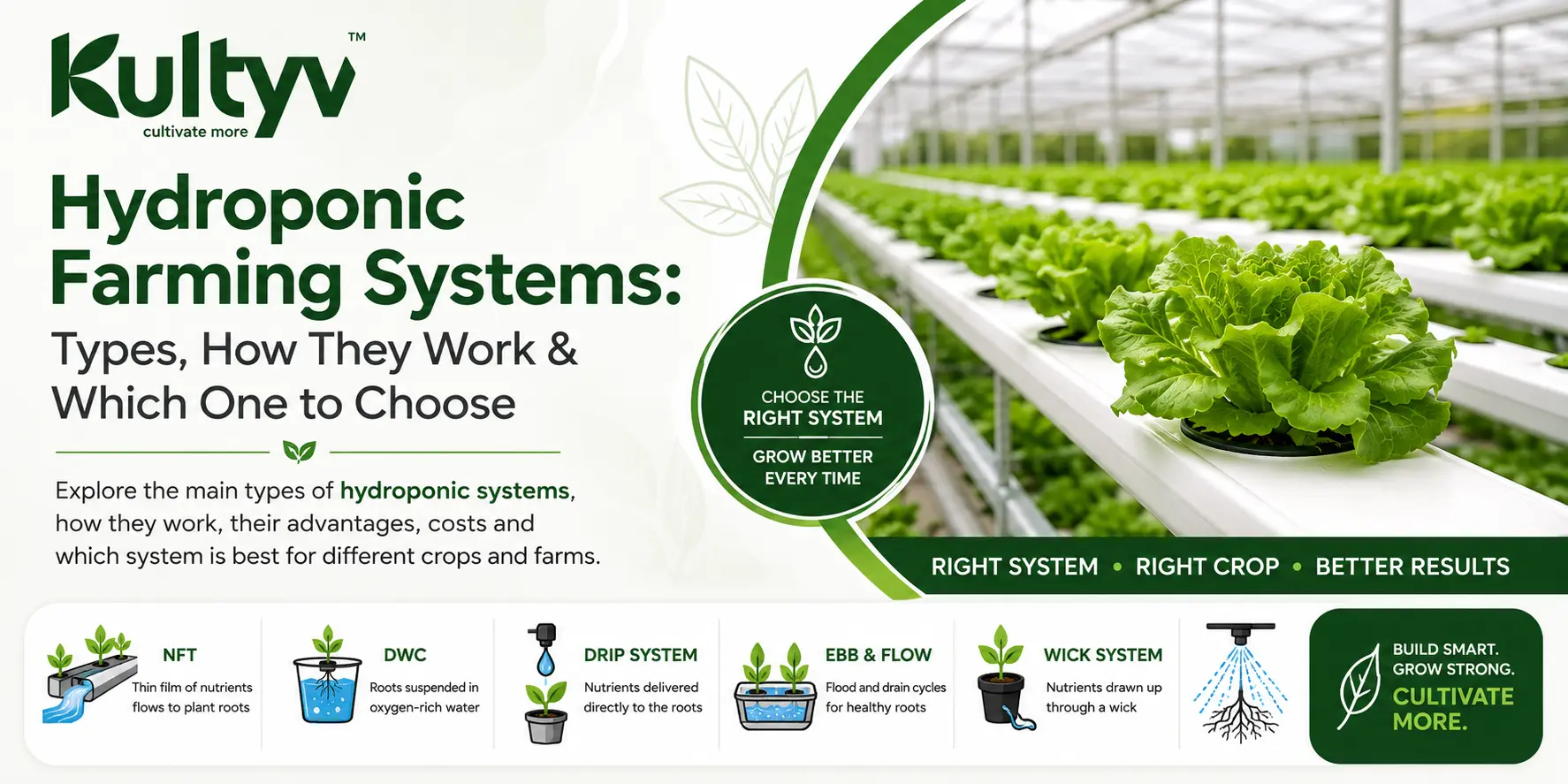
The most common types include:
- Nutrient Film Technique (NFT)
- Deep Water Culture (DWC)
- Drip Hydroponics
- Ebb and Flow
- Wick Systems
- Aeroponics
Let’s look at how each one works and where it can make sense.
1. Nutrient Film Technique (NFT)
Nutrient Film Technique, or NFT, is a hydroponic system in which a thin flow of nutrient solution moves through growing channels.
Plants are positioned along the channels, allowing their roots to access the flowing solution.
The solution then returns to a reservoir, where it can be circulated through the system again.
How NFT works
A typical NFT system includes:
- Nutrient reservoir
- Water pump
- Growing channels
- Plant sites
- Return channels
- Nutrient solution
The pump moves nutrient solution from the reservoir into the growing channels.
The solution flows along the bottom of the channel, providing roots with access to water and nutrients.
It then drains back into the reservoir.
Advantages of NFT
NFT can be useful because it:
- Uses relatively little growing medium
- Allows nutrient solution to circulate
- Can be arranged efficiently in growing spaces
- Works well for certain fast-growing crops
- Can be adapted to commercial production
Limitations of NFT
NFT systems also require careful design.
Water flow needs to be maintained consistently, and problems with pumps or circulation can affect plants quickly.
The system is therefore best suited to operations that can monitor and maintain the infrastructure reliably.
Crops commonly associated with NFT
NFT is particularly suitable for crops such as:
- Lettuce
- Leafy greens
- Herbs
- Certain compact vegetables
The ideal crop depends on the system’s design and the production environment.
2. Deep Water Culture (DWC)
Deep Water Culture, commonly abbreviated as DWC, is one of the more straightforward hydroponic systems.
In DWC, plant roots are suspended in a nutrient-rich water solution.
The plants are supported above the reservoir while their roots extend into the solution.
Because the roots remain in water, oxygenation becomes an important part of the system.
How DWC works
A typical DWC setup includes:
- Reservoir
- Nutrient solution
- Plant support
- Air pump
- Air stones or another aeration mechanism
The plants receive nutrients directly from the water while aeration helps provide oxygen to the root environment.
Advantages of DWC
DWC can offer:
- A relatively simple system design
- Direct nutrient availability
- Straightforward root access to water
- Potentially low mechanical complexity
Limitations of DWC
Because roots remain immersed in the nutrient solution, water temperature, oxygenation and water quality need to be managed carefully.
A problem with aeration or water conditions can quickly affect the root environment.
3. Drip Hydroponics
Drip hydroponics uses irrigation lines and emitters to deliver nutrient solution directly to individual plants.
Instead of continuously flowing nutrient solution through a channel, the system supplies plants through controlled irrigation.
How drip hydroponics works
A typical drip system includes:
- Nutrient reservoir
- Pump
- Main irrigation line
- Smaller distribution lines
- Drippers or emitters
- Growing containers or bags
- Growing medium
The nutrient solution is pumped through the irrigation network and delivered to each plant.
Depending on the system design, excess solution may be collected and returned to the reservoir or allowed to drain away.
Why use a drip system?
Drip systems can provide precise delivery to individual plants and can be adapted to a wide range of crops.
They can also work particularly well with container-based production and growing media.
For commercial operations, the ability to control irrigation across many plants can make drip systems attractive.
Crops
Drip hydroponics can be used for crops including:
- Tomatoes
- Cucumbers
- Peppers
- Strawberries
- Other fruiting crops
The exact system configuration depends on crop requirements and production conditions.
4. Ebb and Flow Hydroponics
An ebb-and-flow system, sometimes called a flood-and-drain system, periodically floods the growing area with nutrient solution before allowing it to drain back into a reservoir.
The process creates cycles of irrigation and drainage.
How it works
During the irrigation cycle, nutrient solution is pumped into the growing area.
Once the desired level is reached, the system stops filling and the solution drains back into the reservoir.
The process then repeats.
This allows the root environment to receive water and nutrients while also having periods where air can occupy the spaces around the roots.
Advantages
Ebb and flow systems can:
- Provide periodic nutrient delivery
- Support a variety of growing media
- Be adapted to different plant arrangements
- Allow roots access to both moisture and air
Limitations
The system depends on reliable pumps, drainage and timing.
A poorly designed drainage system can create problems with water distribution or root-zone conditions.
5. Wick Systems
Wick systems are among the simplest forms of hydroponic growing.
A wick connects the growing medium to a nutrient reservoir and draws nutrient solution toward the plant through capillary action.
Unlike many other hydroponic systems, a wick system does not necessarily require an active pump.
Advantages
Wick systems can be:
- Simple
- Low-maintenance
- Relatively inexpensive
- Suitable for small-scale applications
Limitations
The passive delivery mechanism limits how much water and nutrients can be supplied.
For that reason, wick systems are generally more appropriate for smaller growing setups and plants with relatively modest water requirements than large commercial farms.
6. Aeroponics
Aeroponics is a highly controlled form of soilless cultivation in which plant roots are suspended in air and supplied with nutrient solution through a mist.
Unlike conventional hydroponic systems where roots may sit in water or a growing medium, aeroponic systems expose the roots directly to the air environment.
How aeroponics works
A typical aeroponic system includes:
- Reservoir
- Pump
- Spray or misting system
- Root chamber
- Plant support
- Environmental controls
The nutrient solution is converted into a fine mist and delivered to the roots.
Why aeroponics is different
The system gives growers significant control over the root environment.
However, that control comes with greater technical requirements.
Misting equipment, pumps and environmental conditions need to be carefully managed.
Aeroponics therefore sits at the more technically demanding end of soilless cultivation.
Hydroponic Farming Systems Compared
Choosing between systems becomes much easier when their characteristics are compared directly.
| System | How Roots Receive Nutrients | Complexity | Suitable Applications |
|---|---|---|---|
| NFT | Flowing nutrient solution | Medium | Leafy greens, herbs |
| DWC | Roots suspended in nutrient solution | Low–Medium | Leafy greens, herbs, selected larger crops |
| Drip | Nutrient solution delivered through emitters | Medium | Tomatoes, cucumbers, peppers, strawberries |
| Ebb & Flow | Periodic flooding and drainage | Medium | Various crops and growing media |
| Wick | Passive capillary movement | Low | Small-scale growing |
| Aeroponics | Nutrient mist delivered to exposed roots | High | Advanced controlled cultivation |
There is no single “best” hydroponic farming system.
The right choice depends on what you are growing, where you are growing it and how you intend to operate the farm.
Which Hydroponic System Is Best for Different Crops?
One of the biggest mistakes when planning a hydroponic farm is choosing the system first and the crop second.
The better approach is to start with the crop.
Different plants have different requirements for:
- Root space
- Water
- Nutrients
- Support
- Growth duration
- Canopy size
- Environmental conditions
- Harvesting
For example, leafy greens can work well with channel-based systems such as NFT.
Fruiting crops such as tomatoes and cucumbers may require more structural support and can be suited to drip-based systems using growing media.
The correct system is therefore the one that supports the crop efficiently and consistently.
Which Hydroponic System Is Best for Commercial Farming?
Commercial hydroponic farming introduces another layer of considerations.
A commercial system needs to be evaluated not only for whether plants can grow in it, but for whether the farm can operate it efficiently at scale.
Important considerations include:
Crop suitability
Does the system support the selected crop throughout its production cycle?
Labour requirements
How much manual work is required for planting, monitoring, harvesting and maintenance?
Water management
How efficiently can the system deliver and recover water?
Nutrient management
Can nutrients be monitored and adjusted consistently?
Reliability
What happens if a pump, sensor or irrigation component fails?
Scalability
Can the system be expanded without redesigning the entire farm?
Economics
Does the expected crop revenue justify the infrastructure and operating costs?
A system that looks attractive on paper may not necessarily be the most commercially viable option.
Components of a Hydroponic Farming System
Although system designs vary, most hydroponic farms rely on several fundamental components.
Reservoir
The reservoir stores the nutrient solution.
Its size depends on the farm’s scale and system design.
Pump
Pumps move nutrient solution through the system.
Pump capacity needs to match the system’s flow requirements.
Growing Structure
This can include:
- Channels
- Containers
- Grow bags
- Towers
- Trays
- Pipes
The structure supports plants and creates the environment in which roots receive water and nutrients.
Growing Medium
Some hydroponic systems use inert or relatively low-nutrient growing media to physically support plants.
Examples can include coco peat and other substrates.
The growing medium is not necessarily responsible for supplying the plant’s nutritional requirements.
Irrigation System
Depending on the design, irrigation may involve:
- Pipes
- Tubing
- Drippers
- Channels
- Spray systems
Monitoring Equipment
Commercial operations may monitor:
- pH
- Electrical conductivity
- Water temperature
- Environmental conditions
- Humidity
- Temperature
The greater the scale of the farm, the more important consistent monitoring can become.
How to Choose a Hydroponic Farming System
Before investing in a hydroponic system, work through these questions.
1. What crop are you growing?
Start here.
Do not choose a system simply because it is popular.
2. How large is the farm?
A small installation and a commercial operation have very different requirements.
3. What is your available infrastructure?
Consider:
- Water
- Electricity
- Growing space
- Greenhouse infrastructure
- Climate control
- Storage
4. How much automation do you need?
Some systems can operate relatively simply, while commercial farms may benefit from automated irrigation, nutrient management and monitoring.
5. What is your labour capacity?
A system that looks efficient may become expensive if it requires extensive manual intervention.
6. What happens during a system failure?
Consider backup power, pumps, water storage and emergency procedures.
7. What is the economics of the crop?
Ultimately, the hydroponic system needs to support a commercially viable production model.
Hydroponic Farming System Cost
The cost of a hydroponic system can vary significantly.
There is no universal price because the investment depends on:
- System type
- Farm size
- Crop
- Growing structure
- Equipment
- Automation
- Water infrastructure
- Climate control
- Monitoring
- Labour
- Location
A small NFT system and a commercial greenhouse using automated drip irrigation are not comparable investments.
When calculating the cost of a hydroponic farming system, consider both capital expenditure and operating expenditure.
Capital costs may include:
- Growing structures
- Reservoirs
- Pumps
- Irrigation
- Growing channels
- Grow bags or containers
- Monitoring equipment
- Greenhouse infrastructure
- Climate-control systems
Operating costs may include:
- Electricity
- Water
- Nutrients
- Labour
- Seeds or seedlings
- Maintenance
- Packaging
- Crop losses
The system itself is only one part of the economics.
Common Problems With Hydroponic Systems
Hydroponics offers greater control, but that also means growers need to actively manage the system.
Common problems can include:
Pump failure
A failed pump can interrupt nutrient delivery.
Poor oxygenation
Roots require oxygen. Poor aeration can negatively affect root health.
Incorrect nutrient concentration
Nutrient management needs to match crop requirements.
pH imbalance
Changes in pH can affect nutrient availability.
Water temperature problems
Root-zone temperature can influence plant performance and system health.
Clogged irrigation
Drippers, lines and emitters can become blocked if water and nutrient management are not maintained properly.
Environmental problems
Temperature, humidity, light and airflow all influence crop performance.
A hydroponic farm therefore requires both good infrastructure and good management.
Hydroponic Systems for Small Farms vs Commercial Farms
The best system for a small farm may be very different from the best system for a commercial operation.
Small-scale systems
Smaller growers may prioritize:
- Low initial investment
- Simplicity
- Easy maintenance
- Limited automation
- Small growing areas
Systems such as DWC, NFT or simple drip configurations may be appropriate depending on the crop.
Commercial systems
Commercial farms typically need to prioritize:
- Reliability
- Consistent production
- Labour efficiency
- Scalability
- Water management
- Nutrient management
- Monitoring
- Automation
- Crop economics
At commercial scale, the question becomes less about “Can this system grow the crop?”
It becomes:
“Can this system produce the crop consistently and profitably at the required scale?”
That distinction is critical.
Hydroponic Farming Systems in India
Hydroponic farming in India can involve a wide range of production models, from small controlled farms to commercial greenhouse operations.
The right hydroponic system depends heavily on local conditions.
Growers should consider:
- Climate
- Temperature
- Water quality
- Electricity availability
- Infrastructure
- Crop demand
- Market access
- Labour
- Capital investment
- Operating costs
A system that performs well in one region may require significant environmental modifications in another.
For commercial growers, system selection should therefore be based on the entire farm environment, not simply the growing technology.
Hydroponic Farming Systems and Coco Peat
Not every hydroponic system grows plants directly in water.
Some commercial systems use growing media such as coco peat to provide physical root support while irrigation delivers water and nutrients.
This can be particularly useful for container-based or grow-bag production.
The growing medium and irrigation system should be considered together because characteristics such as water retention, drainage and aeration influence how the root environment behaves.
For commercial cultivation, selecting the right substrate for the crop and irrigation strategy is therefore an important part of system design.
Frequently Asked Questions
What is the best hydroponic farming system?
There is no single best system for every farm. The right system depends on the crop, scale, environment, budget, labour requirements and production goals.
Which hydroponic system is easiest to use?
Simple DWC and wick systems can be relatively straightforward for beginners, while commercial systems generally require more infrastructure and management.
Which hydroponic system is best for commercial farming?
Drip, NFT and other controlled systems can be used commercially depending on the crop and farm design. Commercial selection should be based on reliability, scalability, labour, crop suitability and economics.
Which hydroponic system is best for leafy vegetables?
NFT and DWC are commonly suitable for leafy greens, although the optimal choice depends on the specific crop and production environment.
Which hydroponic system is best for tomatoes?
Tomatoes can be grown in several hydroponic configurations, with drip systems and suitable growing media being common approaches for larger plants.
What is the difference between NFT and DWC?
NFT continuously or periodically moves a shallow nutrient solution through growing channels, while DWC suspends plant roots directly in a nutrient solution.
Is aeroponics a hydroponic system?
Aeroponics is generally considered a distinct soilless cultivation method. It shares many principles with hydroponics but delivers nutrients to exposed roots through a mist rather than through a conventional nutrient solution or growing medium.
How much does a hydroponic farming system cost?
The cost depends on the system, farm size, crop, infrastructure, automation and environmental requirements. A small system can be relatively simple, while commercial installations can require substantial infrastructure.
Choosing the Right Hydroponic System
Hydroponic farming is not one technology.
It is an ecosystem of different growing systems designed around one fundamental principle: giving plants controlled access to the conditions they need to grow.
NFT can be highly useful for certain leafy crops.
DWC can provide a simple approach to direct root access to nutrient solution.
Drip systems can offer controlled irrigation for larger crops.
Ebb and flow can provide periodic irrigation and drainage.
Wick systems can keep small-scale cultivation simple.
Aeroponics can take root-zone control even further.
The important question is not which system is the most advanced.
It is which system creates the best balance between crop requirements, environmental conditions, operational complexity and economics.
For anyone planning a hydroponic farm, that is where the real decision begins.
Choose the crop. Understand the environment. Define the production goal. Then choose the system.
And once the system is selected, the next question is just as important:
What equipment is actually required to build and operate it?
That is where hydroponic farming equipment becomes the next part of the equation.