
Hydroponic farming is a method of growing plants without traditional soil, using water, nutrients, oxygen and a controlled growing environment to support plant growth. Instead of relying on soil to deliver nutrients to plant roots, hydroponic systems provide plants with the essential nutrients they need directly through a nutrient-rich solution or growing medium.
As agriculture faces increasing pressure from limited land, water availability, changing weather conditions and the need for more efficient food production, hydroponic farming offers an alternative way to grow crops in controlled environments.
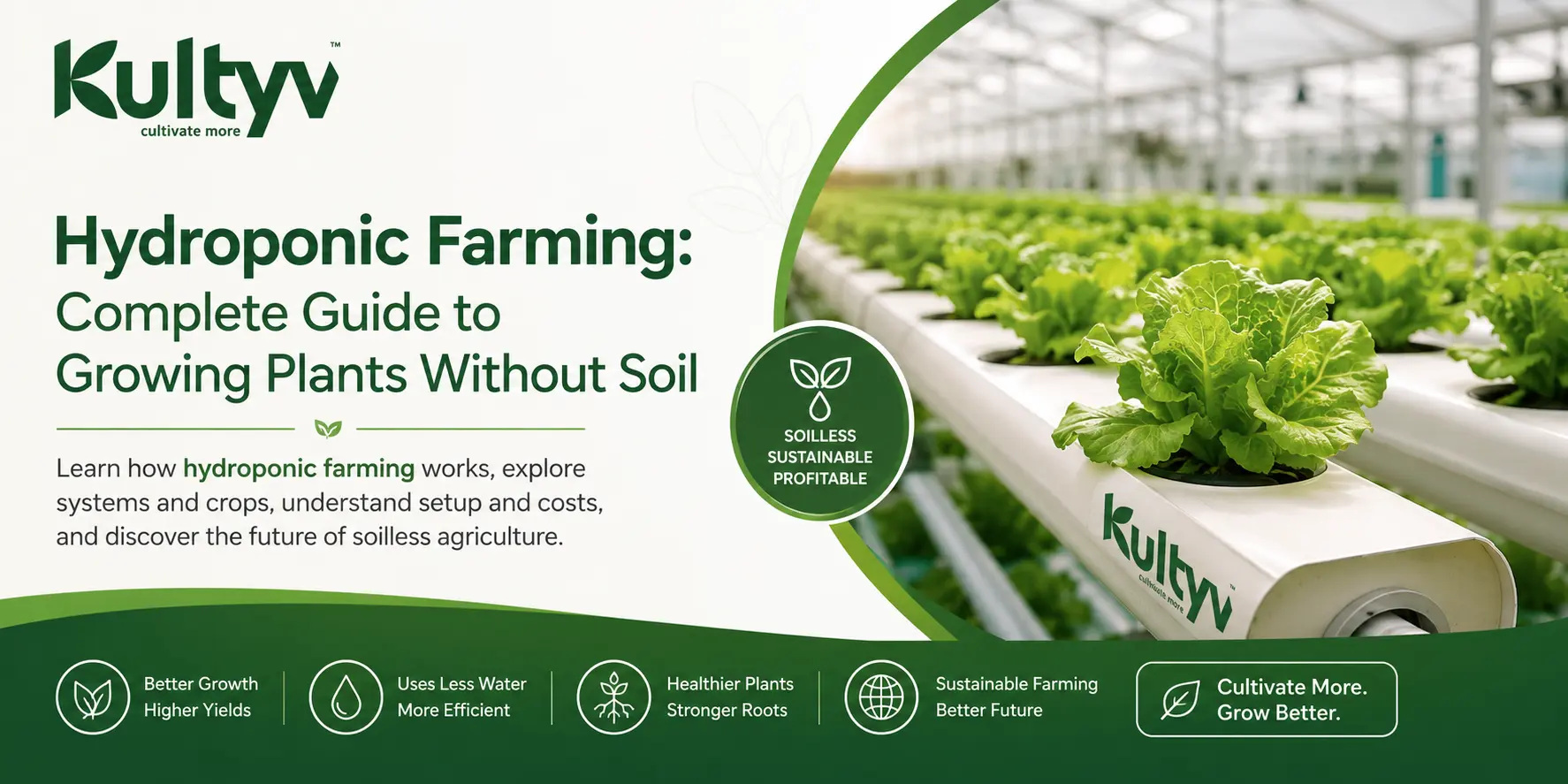
But what exactly is hydroponic farming? How does it work? Which crops can be grown hydroponically? What systems are available, how much does a hydroponic farm cost, and is it actually profitable?
This guide covers the fundamentals of hydroponic farming, from how the technology works to systems, crops, equipment, setup, costs, benefits and commercial applications.
What Is Hydroponic Farming?
Hydroponic farming is a form of soilless agriculture in which plants are grown without conventional agricultural soil.
Instead of soil, the plant receives water, oxygen and nutrients through a carefully managed growing system. Depending on the system, plants may have their roots directly exposed to nutrient-rich water or supported by an inert growing medium.
The basic principle is simple:
Plants do not need soil itself to grow. They need the water, nutrients, oxygen, light and environmental conditions that soil normally helps provide.
Hydroponic cultivation separates these requirements and allows growers to manage them more precisely.
This makes hydroponic farming particularly useful for controlled growing environments, urban agriculture, commercial farms, greenhouses and locations where traditional agricultural conditions may be challenging.
How Does Hydroponic Farming Work?
A hydroponic farming system typically manages five fundamental requirements for plant growth:
- Water
- Nutrients
- Oxygen
- Light
- Environmental conditions
In traditional agriculture, soil acts as a physical support structure and a reservoir for water and nutrients.
In hydroponics, these functions are managed by the growing system.
Plant roots receive a carefully controlled supply of water and nutrients while the plant itself is supported above or within the system.
Depending on the technology being used, roots may be:
- submerged partially in nutrient solution
- exposed to a flowing nutrient solution
- supplied with nutrient solution through drip irrigation
- periodically flooded and drained
- suspended in air and misted with nutrient solution
The objective is to provide plants with the conditions they need while reducing unnecessary variation in the root environment.
What Is a Hydroponic Farming System?
A hydroponic farming system is the infrastructure used to deliver water, nutrients and oxygen to plants while supporting their roots and controlling the growing environment.
There are several types of hydroponic systems, and the right choice depends on factors such as crop type, farm size, available space, environmental conditions, budget and production goals.
1. Deep Water Culture
In Deep Water Culture, plant roots are suspended in a nutrient-rich water solution.
The roots remain in the solution while oxygen is supplied to the water, typically through an aeration system.
DWC can be relatively straightforward to understand and is commonly associated with smaller-scale growing systems.
2. Nutrient Film Technique
Nutrient Film Technique, commonly called NFT, continuously or periodically moves a shallow flow of nutrient solution through channels where plant roots can access it.
NFT is particularly associated with crops that can grow effectively in channel-based systems.
The system requires careful management of water flow and root access to oxygen.
3. Drip Hydroponics
Drip systems deliver nutrient solution directly to individual plants or growing locations through emitters.
This provides growers with control over how water and nutrients are delivered and can be adapted to different crops and growing configurations.
Drip systems can also be incorporated into larger commercial growing operations.
4. Ebb and Flow
An ebb-and-flow system periodically floods the growing area with nutrient solution and then allows the solution to drain away.
This cycle provides plants with access to water and nutrients while allowing the root zone to receive oxygen between irrigation cycles.
5. Wick Systems
Wick systems use a passive mechanism to move nutrient solution from a reservoir toward the growing medium.
They are relatively simple but are generally better suited to smaller-scale applications and plants with appropriate water requirements.
6. Aeroponic Systems
Aeroponics takes the concept of soilless cultivation further by suspending plant roots in air and delivering nutrients through a fine mist.
While aeroponics is often discussed alongside hydroponics, it is technically a distinct method of soilless cultivation.
Kultyv can explore aeroponic farming in greater depth in its dedicated guide to aeroponic cultivation.
What Can You Grow With Hydroponic Farming?
A wide range of plants can be grown using hydroponic systems, although the suitability of a crop depends on its growth characteristics, root structure, environmental requirements and the system being used.
Common hydroponic crops include:
- Lettuce
- Leafy greens
- Herbs
- Tomatoes
- Cucumbers
- Strawberries
- Coriander
- Cabbage
- Capsicum
- Chilli
- Certain root and fruiting crops
Leafy greens and herbs are often well suited to hydroponic systems because of their relatively compact growth patterns and shorter production cycles.
Fruiting crops such as tomatoes, cucumbers and strawberries can also be grown hydroponically, although they may require more sophisticated support, irrigation, lighting and environmental management.
The best crop for a hydroponic farm ultimately depends on the production model rather than simply the crop’s ability to grow without soil.
Hydroponic Farming vs Traditional Farming
The biggest difference between hydroponic and conventional agriculture is the root environment.
Traditional farming depends on agricultural soil, while hydroponic cultivation replaces soil with a controlled system for supplying water, nutrients and oxygen.
| Factor | Traditional Farming | Hydroponic Farming |
|---|---|---|
| Growing medium | Soil | Water and/or inert growing medium |
| Nutrient delivery | Primarily through soil | Controlled nutrient solution |
| Root environment | Influenced by soil conditions | Directly managed |
| Water management | Field irrigation/rainfall | Controlled delivery |
| Land requirement | Usually land-dependent | Can be adapted to controlled environments |
| Environmental control | Often limited outdoors | Can be significantly more controlled |
| Production environment | Primarily open-field or greenhouse | Greenhouse, indoor or controlled environment |
| Crop selection | Broad | Dependent on system and environment |
Hydroponics does not eliminate the biological requirements of farming. Instead, it gives growers more direct control over many of those requirements.
That control can be particularly valuable in controlled environment agriculture.
Hydroponic Farming and Soilless Agriculture
Hydroponic farming is part of the broader category of soilless farming.
Soilless agriculture refers to cultivation methods where conventional agricultural soil is not used as the primary growing environment.
These methods can include:
- Hydroponics
- Aeroponics
- Certain substrate-based cultivation systems
- Other controlled soilless growing methods
This distinction is important because not every soilless farm is necessarily hydroponic in the same technical sense.
Understanding the differences between these approaches allows growers to select the system that best matches their crop and production objectives.
Hydroponic Farming Equipment
A hydroponic farm can contain many different components depending on its size and system design.
Common equipment and infrastructure may include:
- Growing channels or containers
- Reservoirs
- Water pumps
- Irrigation lines
- Drippers or emitters
- Air pumps
- Aeration equipment
- Filtration systems
- Nutrient mixing equipment
- pH monitoring equipment
- Electrical conductivity monitoring equipment
- Environmental sensors
- Growing lights for indoor systems
- Structural support systems
- Climate-control equipment
Commercial hydroponic farms may require substantially more sophisticated infrastructure than small-scale growing systems.
The equipment should therefore be selected based on the crop, production volume, environmental conditions and intended operating model rather than simply purchasing the largest or most complex system available.
How to Set Up a Hydroponic Farm
A successful hydroponic farm starts with planning rather than equipment.
Before installing a system, growers should consider:
1. Choose the crop
Start with the crop and its production requirements.
Different crops have different requirements for temperature, humidity, root space, nutrients, light and structural support.
2. Determine the production scale
A small demonstration system and a commercial farm have very different infrastructure requirements.
Determine the intended production volume before designing the system.
3. Choose the hydroponic system
Select the growing system based on crop requirements, available space, budget, labour requirements and production goals.
4. Plan water and nutrient management
Water quality and nutrient management are fundamental to hydroponic cultivation.
The system should allow growers to monitor and manage the root environment consistently.
5. Design the growing environment
Depending on the farm, this may involve greenhouse infrastructure, shade structures, climate control, ventilation, lighting or environmental monitoring.
6. Install the system
Install reservoirs, irrigation, growing channels or containers, pumps, filtration and monitoring equipment.
7. Establish crop-management processes
A hydroponic farm is not simply an automated irrigation system.
Growers need processes for monitoring plants, water, nutrients, environmental conditions, pests, diseases and equipment.
8. Track production
Commercial operations should track crop performance, resource consumption, production cycles, losses and operating costs.
This information becomes increasingly valuable when scaling a farm.
How Much Does Hydroponic Farming Cost?
The cost of hydroponic farming varies considerably.
There is no single cost that applies to every hydroponic farm because the investment depends on factors such as:
- Farm size
- Crop
- Hydroponic system
- Growing structure
- Greenhouse requirements
- Climate control
- Water infrastructure
- Electrical infrastructure
- Equipment
- Automation
- Labour
- Monitoring systems
- Lighting
- Location
A small hydroponic setup can require relatively limited infrastructure, while a commercial hydroponic farm can involve significant investment in structures, irrigation, environmental control, automation and operating infrastructure.
For that reason, hydroponic farm economics should be evaluated as a complete production model rather than based on the cost of the growing system alone.
Kultyv’s dedicated hydroponic farming cost guide can break this down further by setup type and production scale.
Is Hydroponic Farming Profitable?
Hydroponic farming can be commercially viable, but profitability is not automatic.
The economics of a hydroponic farm depend on the relationship between production costs, crop yield, selling price, market demand, operating efficiency and capital investment.
Important factors include:
- Crop selection
- Selling price
- Production cycle
- Yield
- Labour
- Electricity
- Water
- Nutrients
- Infrastructure
- Packaging
- Transportation
- Market access
- Crop losses
- Farm utilization
- A crop that grows extremely well hydroponically is not necessarily the most profitable crop.
Commercial growers should therefore evaluate both agronomic performance and market economics before choosing what to grow.
Benefits of Hydroponic Farming
Hydroponic cultivation can offer several potential advantages.
More control over the root environment
Instead of depending entirely on soil conditions, growers can directly manage the delivery of water and nutrients.
Efficient use of space
Hydroponic systems can be designed vertically or in other space-efficient configurations, making them suitable for certain controlled-environment applications.
Controlled growing environments
When combined with greenhouse or indoor infrastructure, hydroponic farming can give growers greater control over environmental conditions.
Reduced dependence on agricultural soil
Because plants are not dependent on conventional soil, hydroponic systems can be deployed in environments where traditional soil-based cultivation is less practical.
Data-driven cultivation
Hydroponic systems can incorporate sensors and monitoring technology, allowing growers to track environmental and production conditions.
Potential for year-round production
Where environmental conditions are controlled effectively, farms can potentially produce crops beyond the limitations of a conventional seasonal growing cycle.
However, these advantages depend heavily on good system design and farm management.
Challenges of Hydroponic Farming
Hydroponics also introduces its own challenges.
Initial investment
Commercial infrastructure can require significant upfront capital.
Technical management
Growers need to understand irrigation, nutrients, water quality, environmental conditions and crop requirements.
Dependence on equipment
Pumps, irrigation systems, sensors and other components can become critical to production.
Power requirements
Some systems depend on electricity for pumps, environmental control or lighting.
Crop vulnerability
Problems with water, nutrients, temperature or system operation can affect plants quickly because the growing environment is highly managed.
Skilled management
Technology does not replace agricultural expertise.
A successful hydroponic operation still requires knowledge of crops, plant health, environmental management and farm economics.
Hydroponic Farming in India
Hydroponic farming is increasingly relevant to discussions around modern agriculture in India, particularly where growers are exploring controlled environments, urban agriculture, high-value crops and more efficient production models.
The Indian hydroponics opportunity should not be viewed as a single business model.
A small urban growing system, a greenhouse operation, a commercial leafy-green farm and a large-scale controlled-environment facility can have completely different economics and operational requirements.
For anyone considering hydroponic farming in India, important questions include:
- Which crops have a viable local market?
- What infrastructure is available?
- What does the water supply look like?
- What are the electricity requirements?
- How will produce reach customers?
- What level of technical expertise is available?
- What is the expected production cycle?
- What are the total operating costs?
The strongest hydroponic businesses will ultimately be those that combine good cultivation systems with strong market economics.
Hydroponic Farming vs Aeroponic Farming
Hydroponics and aeroponics are both soilless cultivation methods, but they deliver water and nutrients to plants differently.
In conventional hydroponics, plant roots may interact directly with nutrient solution or a growing medium.
In aeroponics, roots are suspended in air and supplied with nutrients through a mist.
Both approaches can be used in controlled growing environments, but their infrastructure, management requirements and operating characteristics differ.
The right system depends on the crop, production model, environmental conditions, budget and technical capability.
The Future of Hydroponic Farming
The future of hydroponic farming is likely to involve more than simply growing plants without soil.
Modern hydroponic operations can combine cultivation systems with:
- Environmental sensors
- Automation
- Data collection
- Remote monitoring
- Climate control
- Precision nutrient management
- Vertical growing
- Artificial intelligence
- Farm-management software
This creates an opportunity to move agriculture toward increasingly data-driven and controlled production environments.
But technology alone will not determine the success of hydroponic farming.
The fundamental equation remains:
The right crop + the right growing system + the right environment + efficient operations + a viable market.
When those elements work together, hydroponic farming can become much more than an alternative growing technique. It can become a commercially viable approach to controlled agriculture.
Frequently Asked Questions About Hydroponic Farming
What is hydroponic farming?
Hydroponic farming is a method of growing plants without conventional soil by supplying their roots with water, nutrients and oxygen through a controlled growing system.
Is hydroponic farming better than traditional farming?
Neither method is universally better. Hydroponics provides greater control over the root environment and can be useful in specific production models, while conventional agriculture remains highly effective across many crops and environments.
What crops can be grown hydroponically?
Many crops can be grown hydroponically, including leafy greens, herbs, tomatoes, cucumbers, strawberries, coriander, cabbage, capsicum and chilli. The best crop depends on the system and market.
Is hydroponic farming profitable?
Hydroponic farming can be profitable, but profitability depends on crop selection, yield, selling price, infrastructure, labour, energy, water, nutrients, market access and overall operating efficiency.
Is hydroponic farming expensive?
The cost varies significantly depending on farm size, system type, crop, infrastructure, automation and environmental controls. A small setup and a commercial farm can have dramatically different investment requirements.
Does hydroponic farming use soil?
No. Hydroponic systems do not depend on conventional agricultural soil. Some systems may use inert growing media to support plants, but the plant’s nutrients are supplied through the managed growing system.
What is the difference between hydroponics and aeroponics?
Hydroponics generally supplies roots with nutrient solution directly or through a growing medium. Aeroponics suspends roots in air and delivers nutrients through a fine mist.
Can hydroponic farming be done commercially?
Yes. Hydroponic systems can be designed for commercial production, although commercial viability depends on crop selection, farm design, market demand, infrastructure and operating economics.
Final Thoughts
Hydroponic farming is not simply about replacing soil with water.
It is about creating a controlled environment in which the fundamental requirements of plant growth can be managed more precisely.
That makes hydroponics an important part of the broader conversation around soilless farming, controlled-environment agriculture, vertical farming and modern food production.
For growers, investors and agricultural businesses, the most important question is not simply whether a crop can be grown hydroponically.
The better question is:
Can it be grown efficiently, consistently and profitably for a real market?
That is where the future of hydroponic farming will be decided.